Thursday, October 4, 2018

Growth Mindset

This summer I had the opportunity to observe my daughter interact with her little girl. My little granddaughter wanted a toy that was sitting on the ottoman just out of her reach. As she struggled to grab it, my daughter asked her, "How can you problem solve? What else can you do to get the toy?" It struck me how Jenessa was actively teaching Growth Mindset to her then 13 month old. Of course the Little Bug didn't yet understand what was being asked of her BUT, she soon will as she continues to hear to this type of language and encouragement from her parents and others in her life. With a bit of assistance and encouragement, the Little Bug eventually toddled around the other side and claimed her toy. She is lucky to be in an environment where growth mindset is actively taught and she will be less likely to give up on something when the going gets difficult.
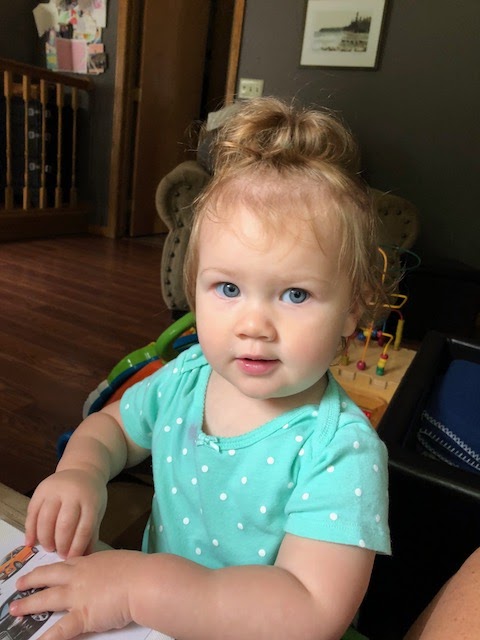
Growth Mindset has begun!

Many students have not yet developed a growth mindset and so this year, I have placed a focus in our classroom on shifting our thinking to developing one. I explained to students that having a growth mindset is understanding that if we only do things we are guaranteed to succeed at, we are not stretching ourselves. We can develop our strengths AND weaknesses through hard work, focus, tenacity, and effort. Growth mindset is making mistakes and understanding that this is part of the growth process. It is knowing that every day there is growth and learning taking place and this allows us to be smarter than we were the day before.

The opposite of having a growth mindset is a fixed mindset. This is the belief that talent and intelligence can't ever be changed. Changing these beliefs can be challenging because they have been so ingrained and many students and adults alike have learned to accept them. A fixed mindset often leads to giving up on tasks, avoiding challenges at school and other areas of life, and feeling badly about oneself. However, focusing on a growth mindset allows one to move forward with tasks that are challenging, taking a risk to try new things, and developing confidence.

An example I gave students of my 10 year old self in a fixed mindset was when I was assigned a new piece of piano music that had several sharps. It was straight out of the old John Thompson red covered piano series. I remember complaining how super hard it was and that I would never get it. Not ever. Then I figured out some strategies. I marked the sharps I kept forgetting, I learned each hand separately, then slowly put both hands together one measure at a time. In this step by step way, I was able to master the piece and eventually it became one of my favorites in the book. The great thing about it was that the piece had been such a challenge, that many other subsequent pieces became a whole lot easier because I had grown as a pianist through that difficult lesson! And I had shifted from a fixed mindset to a growth mindset.
Anyone else remember learning out of these books?

I found an activity online that I decided to use during the first few days of school. I started by writing the following words on a piece of construction paper: determination, creative solutions, effort, mistakes, grit, tenacity, success, capable. As a class, we discussed what each of these words meant and I gave an example of my own for each word. Next I placed each paper around the room and had students go to each one and write an example of their own and/or what the word meant to them. I had them do this silently in order to show respect for classmates' thinking time. 


When the activity was completed, I saved the posters and pulled one poster out to discuss during the next eight morning meetings. I found this was a great way to continue the work we started on growth mindset as well as get students to keep thinking about ways they have observed and engaged in these characteristics. I have found that I am able to refer back to these words in almost everything we do, from naming traits of a book character to celebrating being capable and having success in our writing pieces.

There are many task card games online (or come up with your own) that can be used to get students thinking about how they can shift their thinking from a fixed mindset to a growth mindset. Some examples are, "I have a long math assignment, what can I say to myself?", "You got picked to be the artist in a group project even though you don't like to draw. What can you say to yourself?", "You want to try out for the school play but think you aren't good enough. What can you say to yourself?"

Another growth mindset strategy is to replace an old belief with a new one. Some examples of this include switching "I'm not good at this." TO "What am I missing here?" or "I just can't do math." TO "I'm going to figure out a strategy to do these problems."

We can all use growth mindset every day and encourage our students to as well. Please share some ways you help students focus on growth mindset and/or strategies you use yourself.

Here is the site where I found the original activity.

Monday, September 3, 2018

Acquaintance Maps-Using Technology to Get to Know Your Students

Welcome back to the 2018-2019 school year!

For those of you new to the intermediate grades this school year, this blog was created as a collaborative tool for tier 4 in the Wausau School District. I am excited to once again share ideas, projects, and resources as the school year progresses. Please add your ideas, thoughts, projects, and pieces you have found helpful in context with featured topics in the comments below!


Summer comes to an end...

Every summer's end I reflect on how fast it flew by and the highlights that stand out. While I visited many places I've never been this summer and learned lots of interesting historical and cultural things, I always go back to the people in my life that make the best memories. These "Littles"...my grandkiddos... have brought so much joy and so many smiles to my life. (The "big people" in this picture...my son and daughter...are pretty amazing too!)


Signs of new beginnings...
September means new beginnings and with that the smell of brand new waxy crayons, un-chewed sharpened pencils with a clean eraser at the end, untattered and undoodled notebooks and folders, and nametags that still stick to the desk. School must be starting! 
There's nothing quite like brand new school supplies!

That also means a classroom of fresh excited faces and names to learn. Last year, I posted how to get to know your students on a deeper level through a letter to the teacher and I plan to do that writing piece again this year because I found it to be so valuable. You can find more information on that post HERE

This year instead of pulling out the standard, "find someone who..." sheets to have students and teacher get to know each other, why not try this activity using Mindnode Mind Map? I call this activity Acquaintance Mapping.

Getting Started

Students added colorful backgrounds 
and experimented with various features.

Students start with four categories. I used Family, School, Hobbies, and Vacation, but you can use whatever topics you'd like. From here, students brainstorm specific ideas related to each of these areas they feel describe them. They can include their likes as well as their dislikes. The cool thing about this app is that students can add as many strands extending from the topic as they choose. However, I did give the expectation of a minimum of 3 ideas per topic. There were a few other guidelines I set such as using a mix of both pictures and words, and to be sure everything fits on one screen. Yep, someone tried to see just how far they could extend the lines off the screen!

If students couldn't find an icon that made sense to their ideas, they went online to find a picture that would work.


Students were immediately engaged in this activity. After the Acquaintance Maps were completed, we uploaded them to SeeSaw where everyone could read each other's Maps and find shared interests and commonalities that they might not have otherwise. Students love to comment on each other's posts. I made sure I turned off the "like" option in order to encourage students to be thoughtful and specific in their comments to each other. 

Someone with family connections to Elvis Presley! 
Who knew?? I sense there's a story here!


As a follow up to this activity, as well as digging into our  district literacy goal of using oracy, I gave students some time to get together to discuss their interests further.  The activity definitely helped me understand student likes, dislikes, and interests. This would be a great activity for staff too!

Please share beginning of the year acquaintance activities you find helpful.

Here's to having a fabulous 2018-2019 school year!

Tuesday, May 1, 2018

Growing Green Hair and All Things Summer

Thinking Green and All Things Summer!

It's that time of year when we look forward to being outside in warm weather, blue sky, green grass, and summertime. I am looking forward to activities such as planned vacations,  Chalkfest, gardening, biking the Green Circle in Stevens Point, and hiking up Rib Mountain behind the chalet, to name a few.
Granite Peak Ski Hill, a little slice of summertime Heaven.
The ski chalet really is somewhere at the bottom.


Participating in our local Chalkfest is a great way to take part in a community event as well as discover muscles you didn't know you even owned! (2016)


"Chalking" on the sidewalk is a fun way to grow as an amateur artist. 
Growth Mindset in action!


This is one of my favorite parts of the Green Circle in Stevens Point, Wisconsin. We are so lucky to have this bike trail so close to our community!

But my absolute favorite activity that I'm looking forward to is spending time with my sweet Grand-Kiddos! Two of them!! I foresee lots of travel time to get to these two...each within two hours in opposite directions of Wausau but so worth every mile!
My kids (both successful alumni of the Wausau School District) and their kids! 
First time the new cousins "met" each other!

Some Green What?
We also realize there's still a month of learning ahead of us and engaging students can often become that much more challenging! What better way to bring in some of that anticipated summertime than to grow some Green Hair? Throw in a little bit of scientific inquiry, a bit of observational writing and journaling, a little bit of gardening, and a lot of hands-on!  What kiddo can resist doing Grass Heads?


 Materials to Have on Hand:
All you need is a plastic cup (we used 3 oz. size), a nylon knee high, wood shavings, potting soil, and rye grass seed. Perhaps an eyeball or two. And yarn for pigtails if you want to be stylin' some long green hair! It should be noted that after a number of heads lost their eyeballs, it was discovered that a touch of hot glue (done by an adult only) is the best way to keep them from popping off the head and rolling away! 

How-To:
First, place a teaspoon of rye grass seed in the toe part of the nylon followed by a small scoop of dirt. 
Pull nylon over a larger cup (than the 3 oz.) to 
make the insertion process easier.


Scoop in enough dirt to completely cover the seeds
and give the grass roots some soil to dig into.


The remaining space is filled with wood shavings (found in a pet supply area). The head should be filled full enough so that it looks kinda like a potato. 


Animal Bedding Wood Shavings
A layer of seed, soil, and wood shavings.

Tie off the nylon with a rubber band or simply tie the tail in a knot.  The head will sit mostly on TOP of the plastic cup with only a small bit pushed inside for balance.  The excess nylon will hang down into the water filled cup. If there is a lot of excess nylon, some may need to be trimmed off but it's important to leave it long enough to access the water. This will act as a self-watering system. 


The freshly seeded head will need to be initially watered enough so the seeds and dirt are quite moist. Thereafter, students will need to monitor their cups and add water as it evaporates and possibly re-wet the head if it should become too dry.


All we need now are some eyeballs and a puffball nose.

Grass Head Journals:
Students keep a "Grass Head Journal" to record the needed materials, list step by step procedures, and a couple hypothesis/inquiries of this activity. The journal also contains space to write daily observations, draw sketches, and anything additional done to the heads such as turning  or watering them.
Great place to keep track of all steps,
inquiries, and observations in one spot.
Lots of detail!

The Outcome:
Students were super excited as the green grass hair started to sprout! Observing their Grass Heads is the first thing they want to go see in the mornings.

Little baby sprouts have popped up giving evidence that growth is taking place!

Even if spring has had a big challenge making its way to north central Wisconsin this year,
we have our oh-so-green Grass Heads in the classroom to make up for it!


Looks like we have some shaggy grass heads badly in need of some fashion stylin'.

Students were even more excited when the day finally came for some hair stylin' work! There were attempted braids, trims, pig tails, mohawks, and other interesting do's (and don'ts)! 
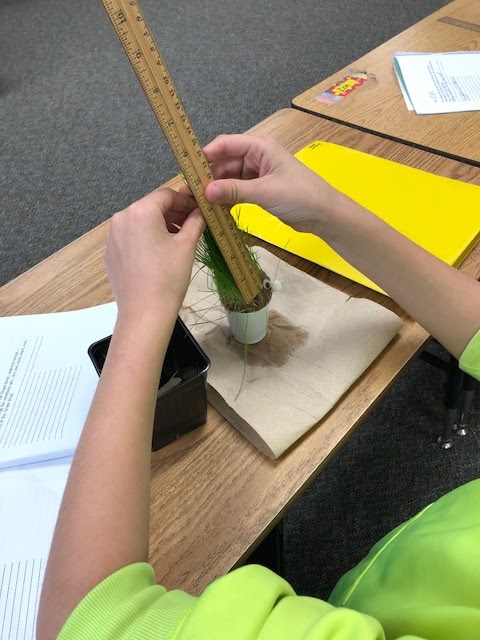
Final measurements before stylin' time begins!
Here we go!

The stylist of this Grass Head said it was styled after his dad's hair! 
And yes, that would be accurate!

The end product CAN be a unique item to give mom for a Mother's Day treat. Kids are so proud of their Grass Heads and what mom can resist a Stylin' Grass Head?


Summer Point of Interest:
One last site to note, especially for those of you local to this area (and extra bonus when you teach latitude and longitude)...if you are interested in standing in the center of the world, there is a small town nearby you won't want to miss checking out! 

Few People Know The Center Of The World Is Actually Hiding In This Tiny Wisconsin Town

Have a safe and fantastic summer!
See you back here in the fall!